

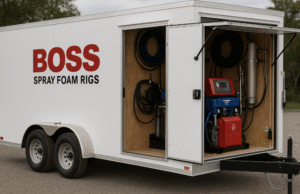
In the fiercely competitive world of home‑improvement and insulation businesses, the right tools don’t just help you keep up—they help you stand out. Investing in advanced, efficient machinery can significantly elevate a contractor’s service offerings, boost profitability, and establish your reputation for excellence. Among these critical investments, a Boss Spray Foam Rig stands out as a powerful asset. Spray foam insulation has become increasingly popular thanks to its energy-saving properties, air-sealing capacity, and durability. For businesses specializing in insulation, roofing, or related retrofit services, having a dedicated spray foam rig can be a total game-changer.
Why? Because spray foam is both a premium offering and a technical service requiring proper equipment. General contractors that already dabble in insulation can now offer spray foam; insulation-specialists can extend into roof coatings or remediation. The Boss Spray Foam Rig is purpose-built to streamline your operation and maximize ROI. As efficiency meets versatility, your business can grow in scale, quality, and profit trajectory.
In this article, we explore why purchasing a Boss Spray Foam Rig for your home-improvement business is a shrewd strategic move—detailing its business benefits, performance advantages, and market potential.
1. 💸 Boosting Profit Margins and Revenue Streams
1.1 Premium Pricing = Greater Profit
Spray foam insulation isn’t a commodity—it’s a specialized service commanding premium pricing. Customers understand they’re paying for superior insulation performance, air-sealing properties, and long-term energy savings. That translates to significantly higher per-job revenue compared to basic fiberglass or cellulose insulation. According to the U.S. Department of Energy, homes insulated with spray foam often experience 20–50% reductions in energy consumption. That kind of ROI supports premium pricing—and customers are willing to pay when they get real energy savings.
A Boss rig enables high-volume sales: whether you’re insulating attics, crawlspaces, rim joists, or exterior walls, the capacity to deploy large line sets translates into seamless project delivery and client satisfaction. Higher volume = more revenue overall; more jobs done per day = more revenue per crew and per month.
1.2 Diversifying Services and Winning Contracts
Owning a Boss Spray Foam Rig means you no longer depend on subcontractors to perform spray foam work. That independence empowers you to:
-
Offer spray foam in bidding packages, making your proposals more competitive.
-
Win retrofit and retrofit-insurance jobs that require spray foam air-sealing.
-
Bundle services: e.g., insulation + air leakage sealing + moisture mitigation.
Voice-of-customer feedback consistently highlights convenience and cost-savings when one trusted company handles multiple services. That significantly boosts bid win-rates and opens the door to higher-margin combinations like roof coating prep or fire-restoration foam sealing.
2. ⚙️ Rig Design + Performance: Engineered for Efficiency
2.1 Industrial-Grade Components
The Boss Spray Foam Rig is engineered specifically for contractors who demand consistency and reliability. Typical rigs feature:
-
Dual heated proportioners: ensure the A-side and B-side resin components are heated evenly—critical for optimal foam quality.
-
High-output spray guns: speeds up coverage and reduces manual fatigue.
-
Large per-hour output: reduced job-time = more jobs per week.
Boss rigs often include features like multi-zone heating, on-board generator, integrated hose reels, and monitoring systems to track usage and performance. All translate into fewer breakdowns, cleaner foam, and more uptime.
2.2 Portability and Adaptability
Boss rigs are designed to be mounted in trucks or trailers, offering:
-
Route-friendly access: maneuver through suburban jobs, commercial complexes, multifamily properties.
-
Self-reliant operation: power output, air conditioning, and hose systems all built into the package.
-
Expandable capabilities: add-ons for flame retardant foam, reflective roof coatings, or cementitious sprays.
This means one investment can support multiple service verticals—a hallmark of strategic business scalability.
3. 🛠️ Operational Advantages: Speed, Quality & Safety
3.1 Faster Turnaround = Reduced Labor Costs
Spraying spray foam manually or with rented equipment is slow and susceptible to heating or pressure issues. A Boss rig keeps materials at the correct temperature and spray pressure, so you get consistent foam output job after job. That translates into:
-
Less on-site rework due to pinholes, voids, or inconsistent spray texture.
-
Faster application speed, reducing labor hours—every hour saved is profit.
-
Optimal yield: proper mixing ensures foam expands as designed, not wasted in overspray.
3.2 Superior Foam Quality = Better Performance
Research from the Department of Energy shows spray foam achieves notable thermal resistance, sealing ability, and moisture control—so long as it’s applied correctly. A Boss rig ensures:
-
Exact A/B chemical ratio, avoiding weak foam or brittle over-cure.
-
Correct temperature levels to preserve foam integrity and lifespan.
-
Controlled spray pattern, enabling professionals to create even, solid insulation layers.
This delivers an end result—tight, energy-efficient homes—that customers love, trust, and recommend.
3.3 Safety First: Proper Ventilation & Controls
Health and safety are crucial. Boss rigs are engineered with:
-
Automatic pressure shut-off in case of hose rupture.
-
On-board ventilation to manage vapors.
-
Built-in control monitors to detect and correct sub-optimal conditions before application.
These features minimize workplace risk, reduce liability exposure, and make compliance with OSHA protocols achievable.
4. 📈 Business Growth: Scalability & Competitive Edge
4.1 Volume Equals Value
When you own the rig, every subsequent foam job adds pure value—your upfront investment is a sunk cost, so every dollar from new contracts goes straight to profit. Assuming you perform, say, 50–100 foam jobs per year, ROI on a Boss rig (mid- to high‑five figures) is often realized within 12–18 months.
Some contractors report ROI in under a year after factoring in:
-
Incremental revenue from higher-margin foam jobs
-
Reduced subcontractor bills
-
Faster turnaround, enabling more concurrent jobs
4.2 Differentiation in Local Markets
Some markets are saturated with fiberglass or cellulose specialists—but few offer dedicated spray foam services with professional-grade equipment. Owning a Boss rig means:
-
Premium branding as a niche insulation expert
-
Preferred status with wholesale chemical suppliers
-
Exclusive bidding for commercial, retrofit, or government energy-efficiency projects
Plus, you can train additional crews under your brand—the network effect kicks in quickly.
5. 🔧 Maintenance and Downtime: What to Expect
Quality machinery does require attention. Boss rigs are built for the field, but contractors should prepare for:
-
Daily warm‑up and cool‑down routines to avoid chemical residue buildup.
-
Quarterly maintenance, including filter changes, hose inspection, and heat-trace testing.
-
Annual calibration: verifying A/B mix ratios and spray gun performance.
Many foam suppliers also offer training and support programs when you register your rig. Investing in maintenance pays dividends in reliability and long-term foam quality.
6. 🧱 Case Study Examples
Case Example: Mid‑Atlantic Insulation Contractor
A company in Pennsylvania upgraded to a Boss rig in 2023. Within six months, they:
-
Won 15 new retrofit contracts that demanded spray foam
-
Increased average job value by 35%
-
Recovered ~70% of the rig’s purchase cost
They reported one standout quote from a homeowner:
“Our energy bills dropped by 40% in the first winter!”
Case Example: Florida Restoration Team
A hurricane-restoration business in Florida added a Boss rig and marketed spray foam as mold- and moisture-resistant restoration. They now offer:
-
Flood-damage foam seal
-
Roof deck moisture insulation
-
Custom air-sealing retrofit
Annual revenue increased by $250k above projections.
7. 📚 Training and Industry Standards
National spray foam training bodies—like the Spray Polyurethane Foam Alliance (SPFA)—stress the importance of professional-grade equipment to:
-
Ensure ICFs and R‑value claims match specs
-
Comply with building codes (IRC, IBC)
-
Use foam safely with respect to ventilation, PPE, and chemical handling
Boss rigs are widely recognized among training centers for meeting or exceeding these standards. Instructors often prefer contractors to train on their own rigs.
8. 💡 Financing, Leasing, and Tax Benefits
8.1 Flexible Procurement Options
Boss rigs can be bought outright or leased with:
-
0% financing for qualified buyers
-
Operating leases: preserving capital
-
Refurbished rigs: budget-friendly entry points
8.2 Tax Incentives and Depreciation
Equipment purchases are capital assets with accelerated depreciation. Thanks to Section 179 in the U.S. tax code, many contractors can write off up to $1 million of equipment in the year of purchase—improving cash flow and reducing tax liability.
9. 📞 How to Choose the Right Boss Spray Foam Rig
9.1 Assess Your Need
-
Are you doing 10 jobs per month? Consider mid-size configurations.
-
Are you expanding into other chemical sprays (roof coatings, flame retardants)? Ensure your rig supports them.
-
Do you need truck-mounted vs. trailer-mounted rigging for jobsite accessibility?
9.2 Dealer Support and Warranty
A major benefit of going with a Boss rig is dealer network support across the U.S. Choose a dealer offering:
-
Warranty and parts availability
-
On-site operator training
-
Technical hotline support
9.3 Accessories and Retrofit
Common accessories include:
-
Remote hose reels
-
Chemical mixing tubs
-
Gun-mounted heaters
-
Foam density and temperature gauges
Your needs may evolve; pick a rig that lets you expand.
💾 Authority & Resources
For further reading, here are some trusted, authoritative references:
-
U.S. Department of Energy—Insulation Fact Sheet on spray polyurethane foam (SPF):
https://www.energy.gov/energysaver -
Spray Polyurethane Foam Alliance (SPFA): certification, best practices, and safety info:
https://www.sprayfoam.org/ -
Occupational Safety & Health Administration (OSHA)—guidance on SPF chemical handling:
https://www.osha.gov/ -
IRS Section 179 deduction: https://www.irs.gov/businesses/small-businesses-self-employed/section-179-deduction
🔚 Conclusion
Investing in a Boss Spray Foam Rig for sale is more than a purchase—it’s a strategic leap for any home‑improvement contractor aiming to:
-
Capture higher-value foam insulation projects
-
Streamline operations with quality equipment
-
Differentiate the brand as a top-tier energy-efficiency specialist
-
Achieve rapid ROI through increased margins and independence
-
Elevate service quality with superior foam performance
By embracing spray foam, you’re not just adding a service—you’re revolutionizing your business model. Whether you’re scaling retrofits, tackling commercial ceilings, or responding to restoration demand, a Boss rig positions your company at the forefront of efficiency, quality, and profitability.
✅ Next Steps
-
Evaluate your current service mix—how many potential spray foam jobs are you missing?
-
Contact a local Boss dealer (a quick Google search will help) to schedule a demo.
-
Plan your financing, including Section 179 if eligible.
-
Schedule crew training—SPFA certification recommended.
-
Promote your new service offering—highlight energy savings, carbon reduction, and tighter building envelopes to attract modern homeowners!
By completing these steps, you’ll be well on your way to building a profitable, differentiated, and future-proof home‑improvement business—powered by a Boss Spray Foam Rig. 🔥