

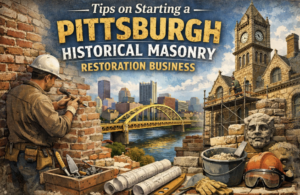
Starting a historical masonry restoration business in Pittsburgh is a smart move if you want to build something meaningful, needed, and rooted in craftsmanship. Pittsburgh has a deep inventory of older brick, stone, and masonry buildings, and that creates a real lane for a restoration company that knows how to protect character while delivering dependable business results. The opportunity is not just in repairing walls. It is in helping property owners, developers, and institutions preserve value, stay compliant, and make older buildings last.
The strongest companies in this space do two things well: they respect historic standards, and they run a disciplined business. If you only focus on masonry skill, growth gets shaky. If you only focus on sales, the work quality suffers. A strong Pittsburgh historical masonry restoration business is built on both.
Learn Pittsburgh’s Historic Review Process Before You Sell Anything
In Pittsburgh, exterior work in local historic districts that is visible from the public right-of-way is reviewed, and approved projects receive a Certificate of Appropriateness (COA). The City’s historic district guidelines are designed to protect the integrity and character of these areas, and they are used by owners, design professionals, contractors, and city staff. The guidelines also tie back to the Historic Review Commission process.
That matters for your business from day one.
If you want to win projects and avoid delays, your company needs to speak the language of approvals. Clients trust contractors who already understand what gets flagged, what usually passes, and how to prepare a cleaner scope of work. This is a huge advantage over contractors who treat historic restoration like regular masonry repair.
Build your workflow around this reality:
-
Document existing conditions clearly
-
Write scopes in preservation-friendly language
-
Plan for review timelines
-
Coordinate early with owners, architects, and consultants
When you become known as the contractor who helps clients move through the process smoothly, you stop competing only on price.
Treat Historic Masonry as a Preservation Trade, Not Just a Repair Trade
Historic masonry restoration is not the same as modern masonry patch work. The National Park Service guidance on repointing historic masonry makes this very clear: improperly done repointing can hurt the appearance and physically damage masonry units. It also emphasizes that the right mortar match and methods matter to long-term building health.
That is one of the biggest business lessons in this niche.
You are not just filling joints. You are managing moisture, material compatibility, appearance, and durability. The NPS guidance also notes that repointing mortars should generally be softer or more permeable than the masonry units and no harder or less permeable than the historic mortar, because overly hard mortar can trap moisture and cause damage.
That means your reputation will grow faster if you build the company around preservation discipline:
-
Mortar analysis and matching
-
Proper joint prep
-
Careful tool selection
-
Moisture and drainage awareness
-
Skilled hand work where needed
-
Clear documentation before and after work
In Pittsburgh, where freeze-thaw conditions and aging masonry can create recurring issues, clients need restoration contractors who understand cause and effect, not just cosmetic fixes.
Pick a Focused Service Menu Instead of Trying to Be Everything
A lot of new contractors lose momentum because they launch with a giant list of services. In this niche, a focused menu helps you build trust faster.
Start with core restoration services that fit historical masonry projects:
-
Repointing and tuckpointing (with historically appropriate methods)
-
Brick and stone replacement in-kind
-
Chimney stabilization and rebuilds
-
Masonry cleaning (safe methods only)
-
Lintel and parapet repair coordination
-
Crack stitching and structural masonry repair support
-
Water intrusion diagnostics related to masonry failure
You can add more later, but in the beginning, clarity wins.
Property owners and preservation-minded clients are not looking for a general “we do it all” pitch. They want confidence that you understand old masonry. A focused service list also helps with estimating, staffing, tools, and marketing. It keeps your messaging sharp and your job costing cleaner.
Build Your Business Legally and Cleanly from the Start
A lot of skilled trades businesses get slowed down by avoidable paperwork mistakes. Pennsylvania’s business filing information explains that forming an LLC involves filing a Certificate of Organization and a docketing statement with the Bureau of Corporations and Charitable Organizations, and the state also points business owners to its online filing services for registration.
On the federal side, the U.S. Small Business Administration lays out the launch basics, including choosing a structure, picking a location, registering the business, getting tax IDs, and applying for licenses and permits. The SBA also emphasizes planning, market research, and writing a business plan.
For a historical masonry restoration company, this is where you create your foundation:
-
Business entity and registration
-
Insurance coverage built for restoration risk
-
Job costing system
-
Contract templates
-
Change order process
-
Photo documentation standards
-
Safety program and training expectations
This part is not glamorous, but it is what protects your margins. Historic restoration projects can uncover hidden conditions. If your contracts and change order process are weak, profit disappears fast.
Train for Craftsmanship and Documentation at the Same Time
In this niche, your field team is your brand.
The best restoration businesses train crews not only to do the work, but to notice details. Historic jobs demand patience and observation. Mortar color, joint profile, brick texture, moisture patterns, previous repair failures, and tool marks all matter.
Teach your team to document everything:
-
Before photos from multiple angles
-
Areas of deterioration
-
Test patches
-
Mortar mix notes
-
Repair sequencing
-
Final photos
This creates three wins:
-
Better quality control
-
Better client communication
-
Better protection if a dispute comes up later
Documentation also helps you market future jobs. Every project becomes proof of your process and care, which is exactly what historic clients want to see.
Build Relationships with Architects, Preservation Consultants, and Property Managers
Pittsburgh historical masonry restoration work often comes through trusted networks, not random one-time calls. If you want stronger projects, build relationships with the people who influence scopes and contractor decisions:
-
Architects
-
Preservation consultants
-
Engineers
-
Property managers
-
Facility directors
-
Developers working on older buildings
The City of Pittsburgh guidelines are used by multiple stakeholders, not just contractors, which is a reminder that historic work is collaborative by nature.
Position your company as a helpful partner:
-
Be easy to communicate with
-
Share realistic timelines
-
Write clean estimates
-
Explain why certain methods protect the building
-
Make it simple for professionals to trust your recommendations
In restoration, your professionalism is often as valuable as your masonry skill.
Price for Restoration Reality, Not Commodity Construction
One of the biggest mistakes in starting this kind of company is pricing jobs like standard masonry repair. Historical restoration has a different risk profile:
-
Unknown substrate conditions
-
Access complexity
-
Slower production rates
-
Matching materials
-
Hand-detail work
-
Review and coordination time
If you underbid to “get in the door,” you can trap your business in stressful, low-margin work. Instead, price for the real scope and explain the value.
Clients who care about historic properties usually understand that good restoration is specialized. They may still compare bids, but they also care about methods, durability, and appearance. Give them confidence with:
-
A clear scope
-
Material assumptions
-
Exclusions and contingencies
-
Alternate pricing if hidden damage is found
-
A strong closeout package
That is how you protect both profit and reputation.
Create a Portfolio That Shows Before-and-After Transformation
Historical masonry is one of the best visual businesses for marketing. Use that.
Every completed project should become a portfolio asset:
-
Before-and-after photos
-
Close-ups of joints and masonry units
-
Notes on what failed and why
-
What method you used to restore it
-
Final result and expected longevity
You do not need a huge website at first. You need a clean, believable one. A small but strong portfolio will outperform a messy site with no proof.
Pittsburgh owners and managers want to see results on older buildings. When your portfolio shows that you preserve character while improving performance, your company starts to feel like the right fit.
Stay Close to Business News and Industry Signals
A restoration business is still a business, and market shifts matter. Financing conditions, commercial real estate movement, labor costs, insurance trends, tariffs, and materials pricing can all affect your projects and margins. Staying informed helps you make better decisions on pricing, hiring, and growth. 📰📈
Build a simple habit: check a handful of reliable business news sources each week. Good examples include Reuters Business, AP Business, Bloomberg Markets, The Wall Street Journal Business, Financial Times Markets, Forbes Business, and for background on the field itself, Wikipedia’s Business Journalism page all publish regular business or markets coverage, and Wikipedia’s page is a helpful overview of the business journalism category.
This habit helps you think like an owner, not only a contractor.
Start Local, Deliver Strong, Then Expand Carefully
Pittsburgh gives you a strong home market, but growth should be earned, not rushed.
Start by building a reputation in a manageable radius. Dial in your operations, your estimating, your crew standards, and your client communication. Once your systems are steady, you can expand into surrounding markets or larger project types.
A smart early growth path looks like this:
-
Win small-to-mid restoration jobs
-
Build a strong visual portfolio
-
Tighten your estimating and margins
-
Collect testimonials
-
Strengthen referral relationships
-
Move into larger and more complex restoration scopes
This keeps your business healthy while your reputation grows.
Conclusion
Starting a Pittsburgh historical masonry restoration business is a real opportunity for a contractor who respects both craftsmanship and business structure. Pittsburgh’s historic building stock, review standards, and preservation culture create steady demand for restoration work done the right way. The companies that win in this space are the ones that understand the materials, honor the process, communicate clearly, and run disciplined operations.
Build your company on preservation knowledge, clean systems, and trustworthy execution. If you do that, you will not just start a business. You will build a name that owners, architects, and property managers remember when an important historic building needs careful hands. 🧱✨